


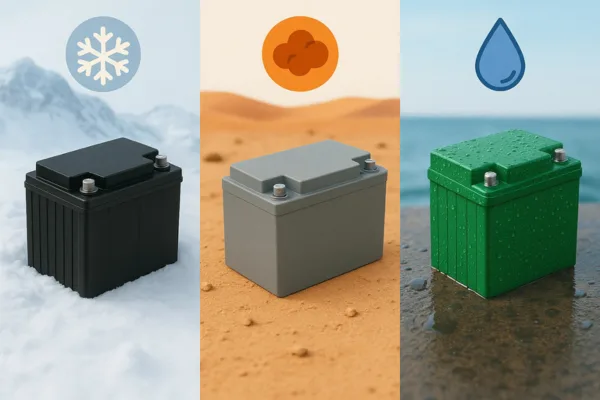
Choosing the right battery is not determined only by voltage or capacity.
The real challenge comes from the environment in which the battery will operate – because extreme conditions such as cold, dust, and moisture can drastically shorten its lifespan.
At EUROGROUP-33, we often design battery solutions that must survive in harsh environments — from mountain temperatures below zero to dusty industrial spaces.
Here is what you need to know if you want your battery to be reliable, long-lasting, and safe, no matter the conditions.
1. Operation in Low Temperatures – Cold and Lithium Are Not Friends
Cold environments are one of the biggest enemies of batteries.
At temperatures below 0°C:
- chemical reactions slow down;
- internal resistance increases;
- capacity can drop by up to 40–50%.
How to choose correctly:
- Use batteries with built-in heating or thermal control;
- Avoid lithium-ion cells without temperature protection;
- For outdoor operation — ensure insulation or a protective enclosure;
- Prefer LiFePO₄ technologies, which maintain stability in low temperatures.
EUROGROUP-33 offers battery solutions with temperature control — ideal for electric vehicles and outdoor installations.
2. Dust and Contaminated Environments – The Invisible Destroyer
Dust may not seem dangerous, but when it accumulates it causes corrosion, overheating, and short circuits.
In industrial or construction environments, batteries must be protected from particulate contamination.
How to choose correctly:
- Look for batteries with IP protection (minimum IP54 for standard environments, IP67 for harsh conditions);
- Ensure the enclosure is sealed and resistant to micro-particles;
- Don’t forget dust-protected connectors — they are often the weak point of the system.
In our industrial projects, EUROGROUP-33 uses battery enclosures with high protection ratings and reinforced sealing.
3. Moisture and Rain – The Most Common Threat to Batteries
Moisture is dangerous not only because it can cause short circuits but also because it leads to slow corrosion of cells and electronics.
Even light condensation inside the battery enclosure can shorten the system’s lifespan by years.
How to choose correctly:
- Choose batteries with a water-resistant enclosure (IP65 or higher);
- For marine or humid environments — use anti-corrosion coating;
- For outdoor systems — add ventilation with a moisture-resistant filter;
- Prevent condensation through temperature stabilization and proper sealing.
4. Combined Conditions – When Challenges Overlap
The hardest environments are those where several factors overlap – for example, cold and moisture, or dust and high temperature.
In such cases you need:
- enhanced temperature control;
- high-grade sealing and insulation;
- durable electronic components;
- regular maintenance and inspection.
EUROGROUP-33 offers customized solutions tailored precisely to these conditions — whether for industry, transport, or autonomous energy systems.
5. How to Extend Battery Life in Any Environment
Regardless of the conditions, there are several universal rules:
- Keep batteries between 20% and 80% charge;
- Avoid prolonged exposure to extreme temperatures;
- Clean contacts and connectors regularly;
- Use high-quality chargers and original components;
- Check the enclosure periodically for signs of condensation, dust, or damage.
The working environment can determine whether a battery will serve 3 years or 10.
Cold, moisture, and dust are not a problem – if you choose the right solution and the right materials.
At EUROGROUP-33, we believe every environment has the battery that fits it – and our mission is to create systems that not only work, but withstand every challenge.
The IP rating indicates the level of protection against dust and moisture. For example, IP54 provides protection against dust and splashes, while IP67 protects against dust and temporary immersion in water. In industrial or outdoor environments, choosing the appropriate IP class is critical for reliability.
Yes. Condensation inside the enclosure can lead to corrosion of the electronics and contacts, which gradually shortens the system’s lifespan. That is why proper sealing and temperature control are extremely important.
There is no universal solution. Every operating environment has specific requirements. Therefore, the choice must be aligned with the actual conditions and load.