


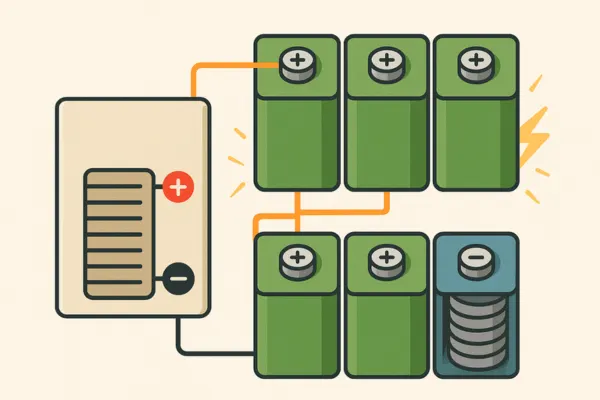
In modern energy and battery systems, one of the most critical components is the BMS — the Battery Management System. It is the “brain” of the battery pack, monitoring the condition, safety, and optimal operation of the cells. Without a reliable BMS, the entire pack may be exposed to risks such as overheating, premature degradation, or serious damage.
What is a BMS?
A BMS is an electronic system that we integrate into our battery packs to ensure:
- monitoring of voltage, current, and temperature of each individual cell;
- charge balancing between cells (cell balancing);
- protection against overvoltage, deep discharge, overheating, and short circuits;
- calculation of remaining capacity (State of Charge, SoC) and battery health (State of Health, SoH);
- communication with external devices (inverters, chargers, controllers).
How It Works? – Key Elements
- Sensors and measurement – real-time data collection for voltage, temperature, and current;
- Cell balancing – through active or passive methods, maintaining uniform charge levels to extend battery life;
- Protection and control – if abnormal values are detected, the system automatically disconnects charging or discharging to prevent damage;
- State assessment – analysis of collected data to calculate SoC and SoH;
- Communication – the BMS transmits information to other system components for precise control.
Smart BMS – Intelligent Battery Management
In addition to standard BMS solutions, at EUROGROUP-33 we also integrate Smart BMS systems that offer:
- built-in wireless connectivity (Bluetooth / Wi-Fi) for remote monitoring via mobile app or web interface;
- detailed real-time diagnostics — voltage, current, temperature, and cell balance;
- predictive maintenance with alerts for potential future issues;
- higher efficiency through intelligent balancing algorithms;
- modularity and flexibility, suitable for both electric vehicles and large-scale stationary battery systems.
The Key Role of BMS in Battery Packs
- Safety: prevents overheating, overvoltage, and short circuits;
- Longer lifespan: reduces cell wear and degradation;
- Optimal efficiency: ensures maximum performance and usable capacity;
- Precise control: provides accurate data on remaining charge and battery condition.
Our Experience at EUROGROUP-33
A BMS is a vital part of every battery pack — it guarantees safety, efficiency, and longer service life. At EUROGROUP-33, we integrate state-of-the-art solutions, including Smart BMS, to ensure reliable and intelligent battery management.
An example of such an application is our 36V 12.6Ah Li-ion e-bike battery, equipped with our own internally developed BMS that protects, manages, and extends the lifespan of the cells.
This is a practical demonstration of our approach — delivering not just batteries, but complete, high-value solutions for our customers.
A standard BMS provides basic protection and balancing functions. A Smart BMS adds intelligent algorithms, remote management, and more detailed diagnostics.
Theoretically yes, but the risk of damage and significantly reduced lifespan is extremely high.