


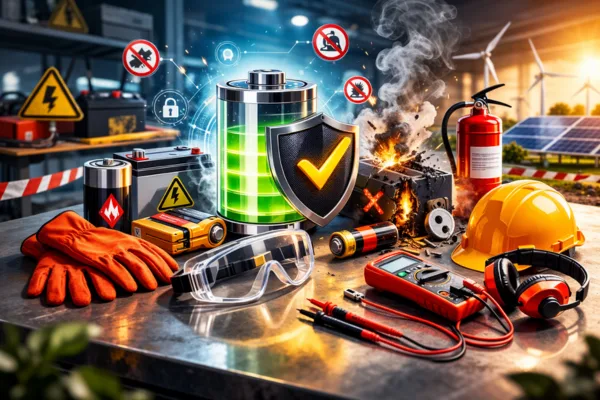
Batteries are an integral part of the modern world – from small consumer devices to industrial energy systems. However, as their capacity and power increase, so does the responsibility when working with them.
Whether it involves lithium-ion, LiFePO4, lead-acid, or industrial battery packs, safety is not a recommendation – it is a mandatory requirement for reliable and long-term operation.
Main Risks When Working with Batteries
Batteries store a large amount of energy in a compact volume. Improper use can lead to:
- short circuits;
- overheating;
- electrolyte leakage;
- fire or explosion;
- electric shock in high-voltage systems.
The risk depends not only on the technology, but also on how the battery is used, installed, and maintained.
Choosing the Right Battery for the Application
One of the most common causes of incidents is using an unsuitable battery.
It is important to consider:
- operating voltage and current;
- environmental conditions – temperature, humidity, dust;
- load profile;
- compatibility with inverters, controllers, and chargers.compatibility with inverters, controllers, and chargers.
A battery suitable for consumer electronics may not be safe for industrial use.
Charging and Discharging
Improper charging is one of the most frequent causes of failure.
It is necessary to:
- use compatible chargers;
- follow recommended charging currents;
- avoid overcharging and deep discharge;
- ensure adequate ventilation during charging.
For lithium-based batteries, the electronic management system plays a key role in preventing risks.
Temperature Control
Temperature is a critical safety factor.
Operation at excessively high temperatures can accelerate degradation and lead to instability. Extremely low temperatures, on the other hand, affect chemical reactions and capacity.
Batteries should be stored and operated within the manufacturer’s recommended range. In industrial systems, additional temperature control measures are often used.
Mechanical Protection and Installation
Batteries must be:
- securely fixed;
- protected from vibration and impact;
- placed in an enclosure with an appropriate protection rating;
- insulated from moisture and dust when necessary.
Improper installation can lead to damage to cells or contact elements.
Working with High-Voltage Battery Systems
In high-voltage systems, the risk of electric shock is real.
Work on such systems must be carried out by qualified personnel using appropriate equipment and protective gear. Clear labeling, insulation, and adherence to shutdown procedures before servicing are required.
Storage and Transport
For storage, it is important that:
- batteries are kept partially charged according to recommendations;
- direct sunlight is avoided;
- they are stored in a dry and ventilated area;
- they are protected from mechanical damage.
Transport must comply with regulations, especially for lithium batteries, which are classified as potentially hazardous goods.
Regular Inspection and Maintenance
Preventive maintenance reduces the risk of incidents.
Periodically check for:
- the condition of cables and connectors;
- signs of swelling or mechanical deformation;
- unusual heating;
- corrosion on contacts.
Early detection of issues prevents serious damage.
The Role of a Professional Approach
Safety is not limited to proper use. It begins at the design and system selection stage.
At EUROGROUP-33 we approach battery solutions with a focus on safety, stability, and compliance with standards. The use of high-quality components, precise assembly, and proper integration with other electronics is the foundation of a reliable system.
Batteries are a powerful and efficient source of energy, but they require attention and responsibility.
Proper selection, correct operation, and professional maintenance ensure safe and long-lasting performance.
Safety is not an addition to the system – it is its foundation.
The battery should be free from mechanical damage, swelling, signs of leakage, or unusual overheating. It should also be used with a compatible charger and in accordance with the manufacturer’s instructions.
Stop using it immediately, disconnect it from the power supply if it is safe to do so, and allow it to cool in a well-ventilated area away from flammable materials. Do not attempt to use it again until it has been inspected.
Do not use the leaking battery and avoid direct contact with the electrolyte. For alkaline batteries, any residue can be carefully cleaned with vinegar or lemon juice. For lead-acid batteries, use a solution of baking soda and water. For lithium batteries, do not use any cleaning agents—take the battery to an authorized collection point for safe handling.